ServicesStair Flooring
Stair Flooring in Missouri City
Stairs take more foot traffic than almost any floor in your home, and they show wear first. We replace worn carpet or tired treads with hardwood, vinyl plank, laminate or new carpet, fitted step by step so the staircase feels solid and matches the rooms around it.
What stair flooring involves
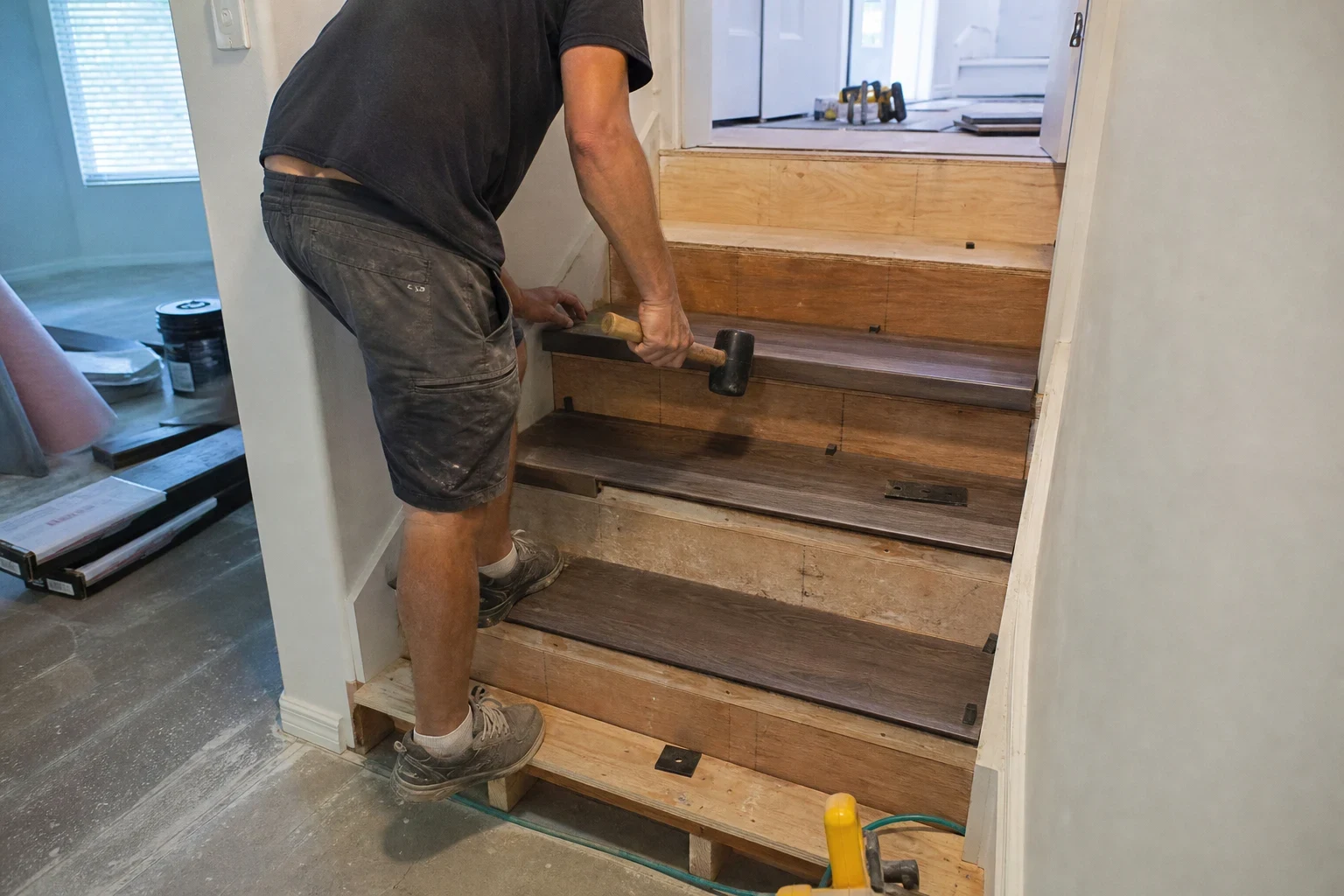
Covering a staircase is slower, fussier work than flooring a room. Every step has a tread to stand on, a riser at the back and a nosing on the front edge, and each one is measured and cut on its own because no two steps in a house are quite the same size.
Many two-story homes around here were built with carpet stretched over plain plywood or particleboard steps. That base is fine under carpet but not meant to be seen, so when you want a hard surface we fit proper treads and risers over it, or replace them where the wood is weak.
It is often the last piece of a bigger project. If we are already putting in hardwood flooring or luxury vinyl plank downstairs, doing the stairs at the same time means one matching look from the entry to the upstairs landing.
What the work includes
- Removing the old covering
- We pull up old carpet, pad and tack strip, and pull every staple left in the steps. Leftover staples are the usual reason new treads rock or squeak, so we take the time to get them all.
- Treads, risers and nosing
- Each step gets a tread, a riser and a front edge suited to the material you choose. On vinyl plank and laminate that means a matching stair nose piece glued and fastened so it does not flex under your heel.
- Checking the steps underneath
- Once the old covering is off, we look at every step for cracks, soft spots and loose fastening. If something needs attention, we show you before we cover it.
- Landings and the floor at the bottom
- We carry the same material across the landing and finish the transition at the top and bottom of the stairs so you do not catch a toe on an uneven lip.
- Carpet on stairs
- If you would rather keep the stairs soft underfoot, we install new carpet and pad wrapped tight around each nose, the same care that goes into our carpet installation in bedrooms and living rooms.
- Cleanup each day
- Stair work makes sawdust and offcuts in a part of the house everyone walks through. We sweep and clear the stairs before we leave so your family can use them that evening.
Signs your stairs are ready for new flooring
Worn paths on the carpet
A matted, flattened strip down the middle of each step, or fraying at the front edges, means the carpet has given all it can.
Squeaks and creaks
A step that squeaks every time someone heads up to bed often has a loose tread or staples working free. New flooring is a good moment to fasten it down properly.
Stairs that do not match
You put new floors in downstairs and the old carpeted staircase now looks out of place. Matching the stairs ties the rooms together.
Slippery or chipped edges
Treads with worn, rounded or chipped nosing are easy to slip on, especially in socks. A crisp, firm edge makes every step safer.
Allergies or pets
Carpet on stairs holds pet hair, dust and dander that a vacuum struggles to reach. A hard surface wipes clean in a minute.
How a stair job runs
- 1
A conversation by phone
You tell us about your staircase, the floors it connects to and what you would like it to look like. We talk through which materials work on stairs and set a time to come see it.
- 2
Measuring every step
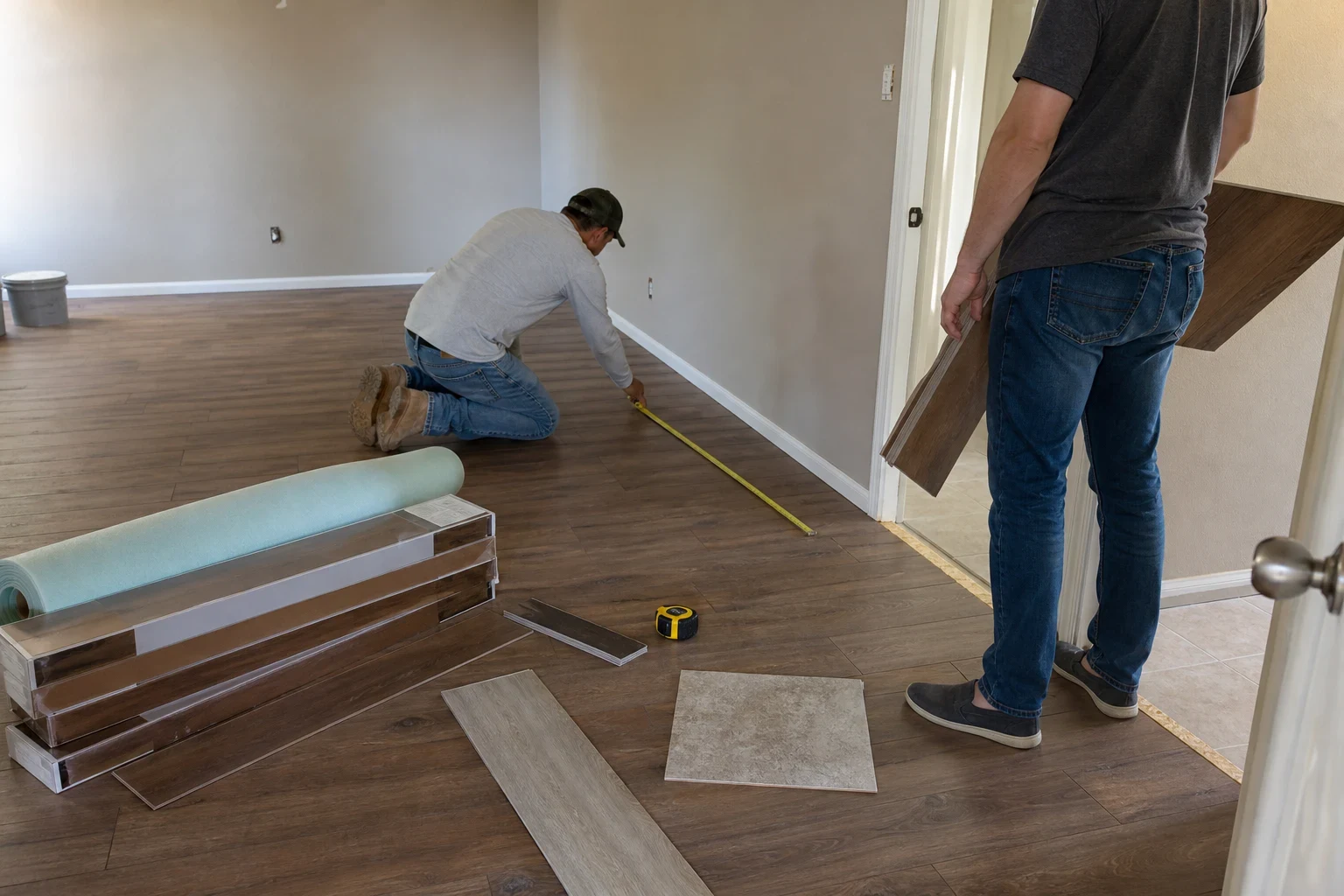
We measure each tread and riser individually, note whether the sides are open or closed, and check how the steps meet the walls and railing. You get a written estimate that lists the work step by step.
- 3
Prep and removal
On the first day we protect the floor at the bottom and the walls along the stairs, then strip the old covering down to the wood and check what is underneath.
- 4
Fitting the steps
We cut and fit each piece working from the bottom up or top down, depending on how you need to get around the house. Most families can still reach the upstairs during the job, and we will tell you ahead of time if there is a stretch when you cannot.
- 5
Walkthrough together
When we finish, we walk the stairs with you, step on every tread and point out anything you should know about curing time for glue before heavy use.
What moves the cost of stair flooring
Stairs are priced by the step more than by the square foot, because the labor of cutting and fitting each one is most of the job. Your written estimate shows how each of the factors below applies to your staircase, so you can see where the cost comes from before anything starts.
- Number of steps and landings
- Every extra step adds another tread and riser to measure and cut. Landings, turns and pie-shaped winder steps each need their own templates, so a staircase that changes direction takes more hours than one that climbs straight up.
- Open or closed sides
- Steps with an open side need finished returns on the tread ends, which takes more material and careful cutting than steps boxed in by walls.
- The material you choose
- Solid hardwood treads are the priciest to buy and the slowest to shape and finish. Vinyl plank and laminate with a matching nose piece usually sit in the middle, and carpet tends to go on fastest, though wrapping it tight around every nose still takes patience.
- Condition of the steps underneath
- Damaged or soft steps, heavy glue or stubborn staples add prep time. We tell you what we find before covering it.
- Railings and balusters
- When balusters sit on the treads, working around them adds time. We discuss the options for your railing during the measure.
Stair flooring questions
Something not covered here? (346) 597-8258
Can I put vinyl plank or laminate on my stairs?
Yes. Both work well on stairs when they are paired with a matching stair nose that is glued and fastened at the front edge. The nosing is what takes the wear and keeps the step feeling firm, so we never skip it or use a loose snap-on piece where a solid one belongs.
Will my new stair treads match my hardwood floors?
We can match species and color closely, especially when we install the hardwood flooring and the stairs together. If your floors are already in, set aside a spare plank or we will look at them in person and talk through the closest options.
Can my family still use the stairs during the job?
Usually yes, with some care. We plan the order of work so there is a way up and down most of the day. If adhesive needs time to set on certain steps, we let you know which ones and for how long.
How long does it take to redo a staircase?
A typical straight staircase takes one to two days of work, depending on the material and what we find under the old carpet. Landings, turns and open sides add time, and we give you a realistic schedule at the measure.
Is carpet still a good choice for stairs?
For a lot of families it is. Carpet is quieter, softer if someone slips and warmer underfoot. If you like that, we can install fresh carpet and pad on the stairs, or carpet the stairs and run hard flooring elsewhere.
Ready for stairs you are glad to climb
Tell us about your staircase and the floors around it, and we will set up a time to measure each step. We serve Missouri City and nearby towns like Sugar Land, Stafford and Pearland.